


In modern agriculture, efficient irrigation systems are essential for saving water, reducing costs, and increasing yield. Among the popular irrigation methods today, Rain Pipe / Rain Hose (Laser Spray) irrigation and Sprinkler irrigation stand out as two widely adopted technologies. While both systems aim to distribute water uniformly over the crop area, they differ in design, cost, efficiency, and suitability for different crops and soil types.
This article provides a detailed comparison between Rain Pipe vs Sprinkler Irrigation, helping farmers choose the best system for their fields.
What is Rain Pipe / Rain Hose (Laser Spray) Irrigation?
Rain Pipe / Rain Hose (Laser Spray) irrigation is a modern and economical irrigation method designed to simulate gentle rainfall on the field. The system consists of a specially designed LLDPE pipe with laser-drilled holes along its length. When connected to a water source, these holes spray water evenly across the field in a fine rain-like pattern.
This system is known by several names such as Laser Spray Irrigation, Rain Hose Irrigation, or simply Rain Pipe System. It is particularly suitable for low heigh close spacing crops.
What is Sprinkler Irrigation?
Sprinkler Irrigation is a more traditional method where water is pumped through a network of pipes and released under pressure through rotating or fixed sprinkler heads. These sprinklers spray water over crops in a circular or semi-circular pattern.
Sprinklers are widely used for a variety of crops, including cereals, fodder and close spaced crops. However, the system involves metal or plastic nozzles, riser pipes, and high-pressure pumps, which make it relatively more expensive and maintenance-intensive compared to Rain Pipe systems.
Comparison of Rain Pipe / Rain Hose (Laser Spray) and traditional Sprinkler Irrigation:
- Laser Spray i.e. Rain Pipe / Rain Hose runs at very low pressure (@0.7 kg/m2 whereas sprinklers require 1.5 to 3.5 kg/m2.
- This enables Laser Spray to run on lowerHP pumps
- This also leads to saving of energy.
- Rain Pipes / Rain Hose ( Laser Spray) is easier to operate and requires lesser maintenance. Laser Spray systems require minimal components – mainly Spray pipes (Rain Pipes / Rain Hoses), connectors, and valves, whereas sprinklers have metal risers, sprinkler nozzles, and relatively complex layouts.
- Laser Spray i.e. Rain Pipe / Rain Hose has low maintenance — no rotating parts or complex mechanisms. Sprinkler systems, on the other hand, have mechanical parts like rotating heads and nozzles that wear out and need regular maintenance.
- Most important point is that sprinkler is widely used on shiftable basis. In this method, the sprinkler laterals (pipes with sprinkler heads) are manually shifted after irrigating one section of the field to cover another section in order to save on investment on pipes and nozzles. Laser Spray (Rain Pipe / Rain Hose) being economical, this is not called for. So Laser Spray (Rain Pipe / Rain Hose) is much less labour intensive than traditional sprinkler.
- Rain Pipe / Rain Hose (Laser Spray) sprays fine droplets over the surface, maintaining soil moisture with minimal seepage loss. It is ideal for sandy soils, where deep percolation losses are high under other systems
- Water drops from Laser Spray i.e. Rain Pipe / Rain Hose are very fine. Unlike sprinkler,they do not compact the soil.
- Water drops from Laser Spray do not harm fruits and flowers being very fine.
- Finally, Laser Spray i.e. Rain Pipe / Rain Hose is economical than sprinkler
Beside the above advantage, Laser Spray (Rain Pipe / Rain Hose) has several other benefits:
- Promotes rapid and even germination of seeds by keeping the soil porous as it maintains balance between air and water in the soil by not flooding it.
- Improves photosynthesis by cleaning the leaves of coriander and thereby enhances the growth of the crop.
- Washes away insects and thus, reduces the need for pest control spray.
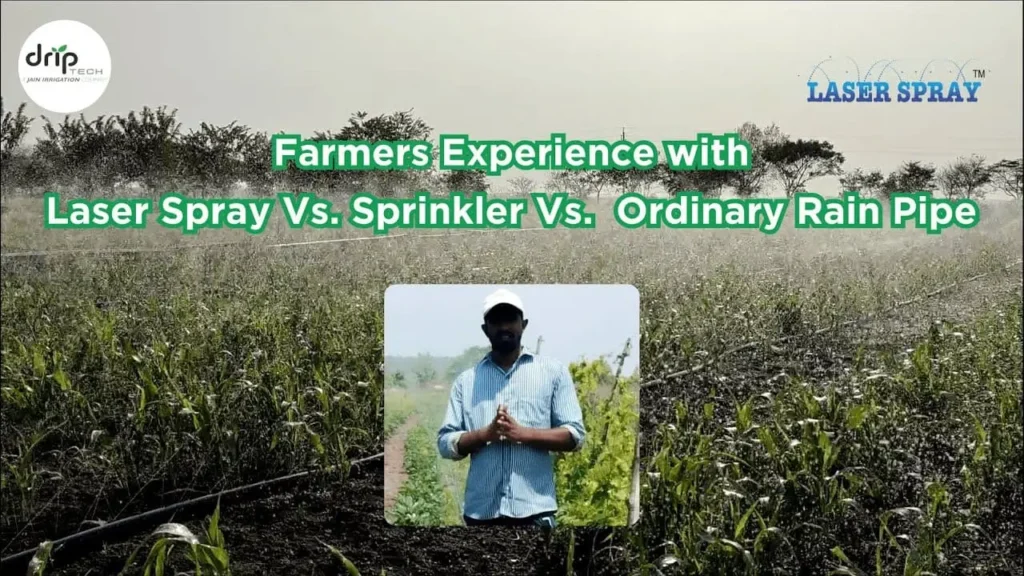
Here are some videos of real farmer experiences using Driptech Rain Pipe (Laser Spray) in Field:
https://www.youtube.com/watch?v=QGUAGdIKBJc
Their success proves how Laser Spray irrigation can transform fenugreek farming by delivering better yields with fewer resources.
How Does Rain Pipe / Rain Hose (Laser Spray) Irrigation Save Money on Investment.
Conclusion: Why Rain Pipe vs Sprinkler Irrigation Favors Laser Spray
When comparing Rain Pipe / Rain Hose (Laser Spray) irrigation and Sprinkler Irrigation, the advantages of the Rain Pipe system are clear — lower initial and running cost, easy setup, minimal maintenance, low pressure operation, and agronomical advantages like improved photosynthesis, insect control, no compaction of soil and suitability for sandy soil etc.
FAQ
1. Which one is more affordable for farmers?
Rain Pipe is usually more cost-effective, requiring lower investment, fewer parts, and cheaper installation.
Sprinkler systems have higher upfront costs due to HDPE pipes, risers, nozzles, and fittings.
2. Which system works at lower water pressure?
Rain Pipe works efficiently at 0.7 kg/cm².
Sprinklers usually require 1.5 to 3.5 kg/cm² depending on nozzle size and type.
3. Which system is easier to install?
Rain Pipe (Laser Spray) is very easy to install.
Sprinkler systems involve complex installation with multiple pipes, joints, and risers.
4. Which system requires more maintenance?
Sprinklers require more frequent maintenance, including nozzle cleaning, lubrication, and part replacement.
Rain Pipe requires minimal maintenance due to fewer moving parts.
5. Which system is recommended for small and medium farmers?
Rain Pipe (Laser Spray) is recommended because it offers lower cost, easy installation, and can be run on low pressure.
 +91 80079 78080 / +91 73910 64282