


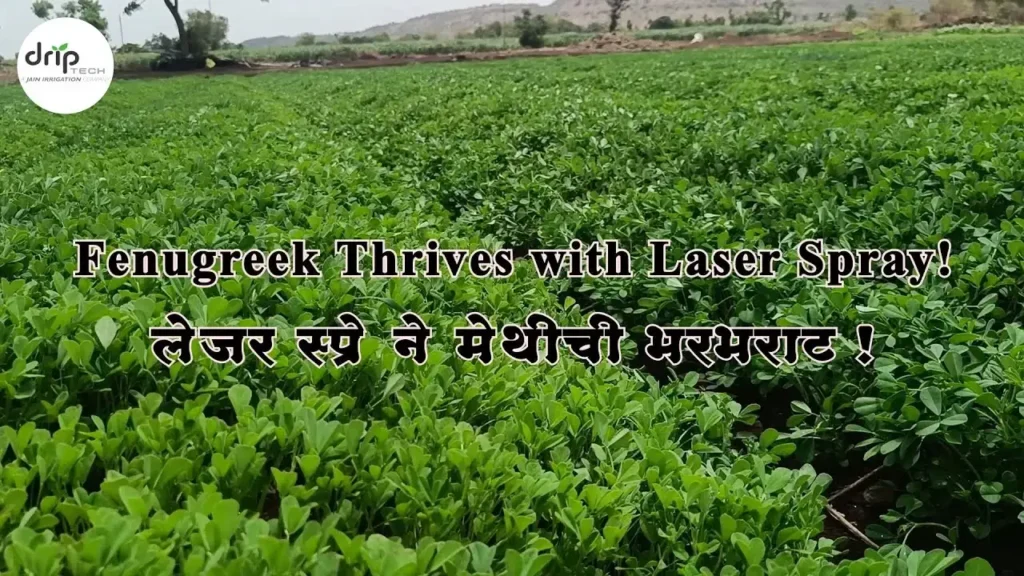
Introduction
Fenugreek (Trigonella foenum-graecum), locally known as Methi, is one of India’s most popular leafy vegetables and spice crops. Valued for its nutritional and medicinal properties, fenugreek is grown throughout the country for both domestic consumption and export. It is rich in protein, fiber, iron, and vitamins. It is a highly profitable crop for farmers.
However, for achieving a high yield and good-quality leaves or seeds, efficient irrigation management is crucial. Fenugreek requires uniform soil moisture throughout its growth cycle, especially during germination and leaf development stages. Traditional irrigation systems such as flood or basin irrigation often lead to water wastage, uneven moisture, and increased disease risk due to water stagnation with Rain Pipe Irrigation for Fenugreek.
To overcome these issues, farmers are shifting toward Rain Pipe / Rain Hose (Laser Spray) irrigation — a modern and efficient micro-irrigation technology that delivers uniform water through fine sprays, mimicking natural rainfall. This system helps conserve water, reduce labor, and maintain uniform soil moisture, ensuring better growth and yield in fenugreek cultivation.
What is Rain Pipe / Rain Hose (Laser Spray) Irrigation?
Laser Spray irrigation, also referred to as Rain Pipe / Rain Hose irrigation, is an innovative form of micro-irrigation technology designed to simulate natural rainfall. The pipe is made from durable polyethylene material and has laser-punched holes that release fine water droplets over a large area.
Unlike traditional systems, Laser Spray (Rain Pipe / Rain Hose)irrigation provides soft and uniform water distribution across the field, preventing soil compaction. It is easy to install, lightweight, and compatible with low-pressure water sources.
The Driptech Rain Pipe system is particularly beneficial for leafy vegetables like fenugreek, as it maintains consistent soil moisture and also helps wash away dust and small insects from the leaves, promoting healthier plant growth.
Key Benefits of Rain Pipe / Rain Hose (Laser Spray) Irrigation
• Provides natural rain-like irrigation for uniform soil moisture.
• Improves seed germination and ensures healthy root development.
• Reduces water consumption by up to 50% compared to flood irrigation.
• Maintains soft and loose soil texture ideal for shallow-rooted crops like fenugreek.
• Prevents soil erosion and waterlogging.
• Washes away insects and dust from leaves, reducing pest infestation.
• Improves photosynthesis and enhances leaf color and texture.
• Reduces heat stress during hot summer days.
• Easy to install, lightweight, and low in maintenance cost.
• Compatible with fertilizers and nutrients through fertigation systems.
Farmers using Driptech Rain Pipe or Laser Spray irrigation system report improved yield, reduced irrigation time, and significant savings on water and labor costs.
Models of Laser Spray (Rain Pipe / Rain Hose) Suitable for Fenugreek
Farmers can select different models based on land size, crop spacing, and irrigation pressure. Commonly used models include:
a. Laser Spray (Rain Pipe / Rain Hose)20 mm
b. Laser Spray (Rain Pipe / Rain Hose)20 mm Gold
c. Laser Spray (Rain Pipe / Rain Hose)32 mm
d. Laser Spray (Rain Pipe / Rain Hose)40 mm
e. Laser Spray40 mm Marathon (Rain Pipe / Rain Hose)– ideal for long plots
Each model of Driptech Rain Pipe offers reliable performance, uniform spray distribution, and long service life, making it suitable for fenugreek.
Crop Spacing Practiced in Fenugreek Cultivation
Proper spacing ensures good air circulation, better sunlight exposure, and effective irrigation coverage. The recommended spacing is:
-
- Row-to-Row: 20–25 cm
-
- Plant-to-Plant: 5–10 cm
This spacing allows uniform water and nutrient distribution, resulting in strong, healthy plants and higher leaf biomass.
Laser Spray (Rain Pipe / Rain Hose) Rain Pipe Irrigation for Fenugreek Installation Spacing
| Model | Recommended Spacing (m) | Recommended Laying Length (m) |
| Laser Spray 20 mm | 3 | 50 |
| Laser Spray 20 mm Gold | 3 | 50 |
| Laser Spray 32 mm | 6–7 | 50 |
| Laser Spray 40 mm | 6–7 | 50 |
| Laser Spray 40 mm Marathon | 6 | 100 |
Following this layout ensures that the entire field is uniformly irrigated, avoiding dry spots and over-watering.
Results of Rain Pipe / Rain Hose (Laser Spray) Irrigation on Fenugreek
1. Enhanced Germination and Root Development
Fenugreek seeds are small and sensitive to moisture variations. The fine spray from Driptech Rain Pipe ensures consistent soil moisture, promoting faster and more uniform germination. Proper moisture also encourages deep and healthy root growth, strengthening the plant foundation.
2. Uniform and Tender Leaf Growth
With uniform irrigation, fenugreek plants grow evenly across the field. The soft, rain-like spray ensures that leaves remain fresh, tender, and bright green — qualities highly valued in the market. Balanced soil moisture improves nutrient uptake and boosts leaf yield.
3. Higher Yield and Better Quality
By maintaining ideal soil moisture and humidity levels, the Laser Spray irrigation system enhances plant photosynthesis and overall productivity. The result is higher leaf biomass and better-quality produce with enhanced flavor and aroma. For seed production, it leads to uniform pod formation and better seed viability.
4. Prevention of Crop Wilting and Heat Stress
Fenugreek crops are sensitive to extreme heat. The Rain Hose irrigation system helps in cooling the crop canopy by maintaining surface humidity, thereby preventing wilting and leaf burn. This protective cooling ensures consistent growth even under dry conditions.
5. Reduced Pest Infestation and Pesticide Use
Continuous water misting from Laser Spray irrigation naturally removes dust, aphids, and other small insects from fenugreek leaves. This reduces pest population and minimizes the need for chemical spraying. Farmers can save both on pesticide costs and labor.
6. Improved Soil Health and Aeration
Unlike flood irrigation, Driptech Rain Pipe prevents waterlogging. It maintains balanced moisture without compacting the soil, promoting microbial activity and better nutrient absorption. Over time, this results in improved soil fertility and sustainability.
7. Lower Labor and Maintenance Costs
Laser Spray systems are easy to lay, connect, and remove. They require minimal supervision and reduce the need for manual watering. Their durable design provides years of reliable service with minimal maintenance, saving time and energy.
Users’ Testimonials
Many farmers in India have adopted Rain Hose( Laser Spray) irrigation for Fenugreek and shared positive experiences. They have reported:
-
- Faster germination and uniform crop stand.
-
- Improved leaf color and quality.
-
- 40–50% water savings compared to traditional irrigation.
-
- Reduced electricity and labor costs.
-
- Fewer pest attacks due to clean foliage.
Here are some videos of real farmer experiences using Driptech Rain Pipein fenugreek cultivation:
https://www.youtube.com/watch?v=LTO_fJZlJaw
https://www.youtube.com/watch?v=zYOfL_f3d3M
……………………………………
Their success proves how Laser Spray irrigation can transform fenugreek farming by delivering better yields with fewer resources.
Conclusion
Fenugreek cultivation with Rain Pipe / Rain Hose (Laser Spray) is an innovative, cost-effective, and sustainable irrigation solution for today’s farmers. This modern micro-irrigation technology ensures uniform water distribution, improved germination, enhanced leaf quality, and reduced pest problems — all while conserving water and energy.
Adopting the Driptech Rain Pipe system helps farmers achieve higher yields, better crop quality, and lower operational costs. Whether grown for fresh leaves or seeds, fenugreek responds exceptionally well to Rain Pipe / Rain Hose (Laser Spray) irrigation, making it one of the best irrigation systems for sustainable agriculture.
Farmers aiming for profitable and eco-friendly fenugreek farming should consider upgrading to Rain Pipe / Rain Hose (Laser Spray) — a smart irrigation technology that brings long-term benefits for productivity, profitability, and soil health.
FAQ
-
- What is the spacing for rain hose irrigation?
| Model | Recommended Spacing (m) | Recommended Laying Length (m) |
| Laser Spray 20 mm | 3 | 50 |
| Laser Spray 20 mm Gold | 3 | 50 |
| Laser Spray 32 mm | 6–7 | 50 |
| Laser Spray 40 mm | 6–7 | 50 |
| Laser Spray 40 mm Marathon | 6 | 100 |
2. How does a rain pipe work?
Rain Pipe is made from polyethylene material and has tiny holes that release fine water droplets when water is pumped through it under pressure. It creates rain like water jets which wets the land on two sided on the pipe.
3. What is the spray irrigation method?
Spray irrigation involves distributing water evenly over crops using perforated hoses. Unlike drip irrigation, which delivers water directly to the root zone, spray irrigation mimics natural rainfall, ensuring uniform water coverage across the field. This method not only saves water but also helps maintain soil health, reduces erosion, and improves crop quality. It also helps improve photosynthesis by cleaning the leaves and washes away insects and creates cool micro climate.
Laser Spray irrigation creates a fine, even spray over the entire plant canopy, ensuring that every plant receives adequate moisture without over-saturating the soil.
4. What is the lifespan of a spray irrigation system?
It really depends on the manufacturer of the spray irrigation system. The leading brands like ‘Laser Spray’ made of High Quality Virgin Plastic is strong and long lasting. It is does nor deteriorate under the sun or bursts / crack easily and can bear reasonably high pressure.
The life also depends on the care taken in the field and during winding at the end of the season and relaying in the net season.
Please click on this link to see videos on users’ testimonial on the life of Laser Spray:
- Requires high pressure to run
- Prone to dripper clogging. Requires regular maintenance
- Calls for substantial initial investment.
6. What is the cost of rain pipe for 1 acre?
It costs around Rs. 17-18000/- inclusive of all items needed except the main and sub-main pipes.
 +91 80079 78080 / +91 73910 64282