


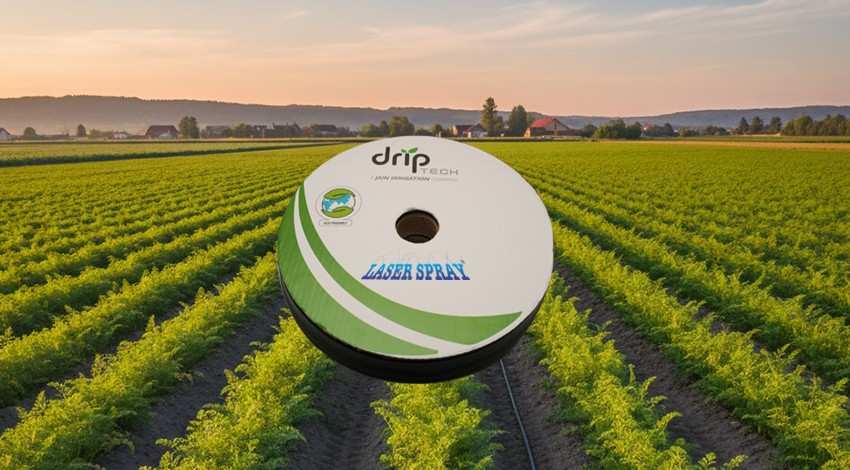
Carrot (Daucus carota) is one of India’s most important root vegetables, grown widely for its crunchy texture, sweet flavor, and high nutritional value. Rich in beta-carotene, vitamin A, antioxidants, and dietary fiber, carrots are in high demand across fresh markets, processing industries, and juice companies.
However, carrot cultivation step by step requires consistent and uniform soil moisture, particularly during seed germination, root initiation, and root enlargement stages. Traditional irrigation methods like flood irrigation often cause soil crusting, nutrient leaching, uneven moisture, and irregular root shape, leading to reduced yield and poor-quality carrots.
To address these challenges, farmers are increasingly adopting Rain Pipe / Rain Hose (Laser Spray) irrigation, an advanced micro-irrigation technology that delivers uniform water in the form of fine sprays. This method supports ideal soil moisture, improves root quality, conserves water, and reduces labor — making it highly suitable for carrot cultivation cultivation step by step.
What is Rain Pipe / Rain Hose (Laser Spray) Irrigation?
Laser Spray irrigation, commonly called Rain Pipe / Rain Hose, is a modern irrigation system made from high-quality polyethylene pipes with laser-punched micro-holes. These holes create a gentle, rain-like spray that spreads evenly across the soil surface.
Why Spray Irrigation is a boon for farmers
Laser Spray (Rain Pipe / Rain Hose) irrigation is technically called Spray Irrigation and it substitutes traditional sprinklerirrigation. It stands out with many benefits:
- Supports Photosynthesis: Clean, healthy leaves are key to efficient photosynthesis. By preventing dust buildup on leaves, the Laser Spray (Rain Pipe) ensures that your plants absorb sunlight more effectively, enhancing growth and yield.
- Gentle on Crops: The Laser Spray (Rain Pipe / Rain Hose) disperses fine water droplets, ensuring that your delicate fruits and flowers aren’t damaged during irrigation. This gentle spray mimics natural drizzle, making it ideal for maintaining healthy crops.
- Boosts Soil Health and Germination: The Laser Spray (Rain Pipe) irrigation keeps the soil porous, which improves air circulation around the roots and enhances seed germination. By spreading water evenly across the soil surface, it also reduces the risk of waterlogging and seepage loss.
- Perfect for Sandy Soil: Sandy soils, notorious for their quick drainage, benefit immensely from the Laser Spray’s (Rain Pipe) thin water distribution on the soil. The water penetrates efficiently, keeping the soil moist without being wasted.
- Washes away Insects: Its rain like watering of the plant washes away the insects resulting in reduction crop protection spray of insecticides.
- Cooling the crop: It cools the crop canopy as well as the soil and thus saves the plants form heat stress.
Why Rain Pipe / Rain Hose for Carrot?
Carrot cultivation step by step is a close-spacing root crop. Since driplines can cover only one or two rows of the crop, it will take an economically unviable quantity of driplelines to irrigate a plot of land with drip irrigation system. Laser Spray (Rain Pipe / Rain Hose) overcomes this limitation as each Spray Pipe can cover multiple crop rows (up to 6–7 meters in the two sides together).Thus, Laser Spray Irrigation becomes an economical and highly efficient choice for carrot cultivation step by step farmers.
Laser Spray (Rain Pipe / Rain Hose) has other advantages for the carrot farmers:
- It keeps the soil uniformly moist from top to bottom — essential for straight root formation.
- It prevents crust formation on the soil surface, aiding smooth emergence of tender carrot seedlings.
- The gentle and fine water drops of Laser Spray (Rain Pipe / Rain Hose) does not wash away the seeds.
Laser Spray (Rain Pipe / Rain Hose) has several advantages over Sprinkler which is also used for close spaced crops:
| Laser Spray | Sprinkler | |
| Working Pressure | 0.7 kg / cm2 | 1.5 to 4 kg/cm2 |
| Pump Required | Lower HP | Higher HP |
| Electricity Consumption | Low | High |
| Maintenance | Low. No moving part | Higher |
| Harm to Fruits and Flowers by the water jets | No | Possible |
| Compaction of soil | No | Possible |
Popular Models of Laser Spray (Rain Pipe / Rain Hose) for Carrot cultivation step by step
a. Laser Spray (Rain Pipe / Rain Hose) 20 mm
b. Laser Spray (Rain Pipe / Rain Hose) 20 mm Gold
c. Laser Spray (Rain Pipe / Rain Hose) 32 mm
d. Laser Spray (Rain Pipe / Rain Hose) 40 mm
e. Laser Spray (Rain Pipe / Rain Hose) 40 mm Marathon – suitable for long field lengths and large farms
All models ensure fine droplet size, controlled pressure, and long durability, suitable for India’s semi-arid and varied climatic conditions.
Crop Spacing in Carrot Cultivation
Proper spacing ensures adequate root development, air circulation, and uniform moisture distribution.
Recommended spacing:
- Row-to-Row: 25–30 cm
- Plant-to-Plant: 5–7 cm
This spacing ensures that each root grows straight, receives equal sunlight, nutrients, and moisture.
Rain Pipe / Rain Hose (Laser Spray) Installation Spacing
The following layout achieves full coverage, uniformity, and prevents dry patches in carrot fields:
| Model | Recommended Spacing (m) | Recommended Laying Length (m) |
| Laser Spray 20 mm | 3 | 50 |
| Laser Spray 20 mm Gold | 3 | 50 |
| Laser Spray 32 mm | 6–7 | 50 |
| Laser Spray 40 mm | 6–7 | 50 |
| Laser Spray 40 mm Marathon | 6 | 100 |
Results of Rain Pipe / Rain Hose (Laser Spray) Irrigation on Carrot
1. Improved Germination and Early Growth
Carrot cultivation step by step seeds need consistent moisture for 10–12 days. Rain Hose ensures fine, light spray that keeps the soil moist, giving uniform and strong seedling emergence.
2. Straight and Uniform Root Formation. The even soil moisture prevents:
- Root forking
- Deformities
- Growth cracks
Farmers get high-quality, market-grade carrots.
3. Higher Yield and Better Productivity
Regular moisture enhances root thickness, length, and weight. Farmers experience 10–20% improved yield using Driptech’ Laser Spray ( Rain Pipe / Rain Hose).
4. Easy Uprooting during Harvest
The soil remains loose under spray irrigation. It does not get compacted. This ensures easy uprooting of the crop while harvesting.
Farmers’ Experiences
Using Driptech Rain Pipe systems, carrot farmers achieve excellent water efficiency, improved crop uniformity, and sustainable production.
Conclusion
Carrot cultivation step by step with Rain Pipe / Rain Hose is a modern, economical, and highly effective irrigation method. It ensures uniform moisture, better germination, higher yields, and superior root quality while saving water and labor.
FAQ
1. Is Rain Pipe suitable for carrot cultivation?
Yes. Carrot cultivation step by step requires light and uniform irrigation. Rain Pipe irrigation provides gentle spray that supports germination, root growth, and prevents soil crusting.
2. What are the benefits of using Laser Spray Irrigation in carrots?
- Low investment
- Lower running cost
- Better germination
- Uniform and straight roots
- Higher yield
- Reduced water consumption
- Cooling effect during heat
- Reduced pest pressure
3. How far apart should Rain Pipes be installed for carrots?
Based on model:
- 20 mm & 20 mm Gold: 3 meters
- 32/40 mm:7 meters
4. Is Rain Pipe cost-effective for carrot growers?
Absolutely.
Carrot cultivation step by step is a close-spacing root crop. Since driplines can cover only one or two rows of the crop, it will take an economically unviable quantity of driplelines to irrigate a plot of land with drip irrigation system. Laser Spray (Rain Pipe / Rain Hose) overcomes this limitation as each Spray Pipe can cover multiple crop rows (up to 6–7 meters in the two sides together).Thus, Laser Spray Irrigation becomes an economical and highly efficient choice for carrot cultivation step by step farmers.
Beside the initial investment, the running cost is also low. Laser Spray ( Rain Pipe / Rain Hose) works on low pressure and hence needs smaller pump and consumes lesser electricity. It also has low maintenance cost as there is no moving part. It is much less labour intensive than sprinkler irrigation.
5. Which Rain Pipe model is best for carrot fields?
For small to medium farms:
- 20 mm or 20 mm Gold or 32 mm
For large and long fields:
- 40 mm, or 40 mm Marathon
6. Can Rain Pipe irrigation be used in different soils?
Yes. It works efficiently in sandy, loamy, and clay soils because it delivers uniform moisture without washing away soil or nutrients.
7. How often should carrots be irrigated using Rain Pipe?
- Daily light irrigation during germination
- Alternate-day irrigation during cooler weather
Avoid excess irrigation near maturity to prevent cracking
 +91 80079 78080 / +91 73910 64282