


Introduction
Groundnut (Arachis hypogaea) is one of the world’s most important oilseed and food crops, widely cultivated across tropical and subtropical regions for edible oil, snacks, confectionery products, and animal feed. It is grown extensively in countries such as China, India, Nigeria, the United States, Sudan, Senegal, Argentina, and Brazil, making it a key crop in both developed and developing agricultural economies. Groundnut kernels are rich in protein, healthy fats, vitamin E, B-complex vitamins, calcium, and essential minerals, contributing significantly to global food security, nutrition, and rural livelihoods.
Successful groundnut cultivation depends greatly on proper water management and good agronomical practices. Groundnut is a shallow-rooted crop in its early stages and later develops underground pods through a unique process called pegging. The crop requires light, frequent, and uniform irrigation during germination, flowering, pegging, and pod development stages. Even short periods of moisture stress can result in poor germination, flower drop, reduced pegging, shriveled pods, and yield loss. On the other hand, excess irrigation causes waterlogging, soil compaction, poor aeration, and increased incidence of fungal diseases such as root rot and collar rot.
Traditional irrigation methods like flood irrigation often fail to meet these precise requirements. Flooding leads to uneven moisture distribution, water stagnation, soil compaction, nutrient leaching, and wastage of water and energy. It also increases labor requirements and creates stress conditions that negatively impact pegging and pod development.
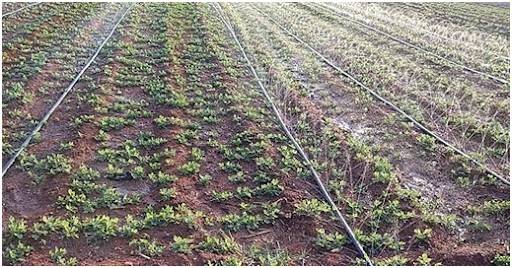
To overcome these challenges, farmers are increasingly adopting Rain Pipe / Rain Hose (Laser Spray) irrigation, an advanced micro-irrigation technique designed to deliver uniform, controlled, and gentle water application.
What is Rain Pipe / Rain Hose (Laser Spray) Irrigation?
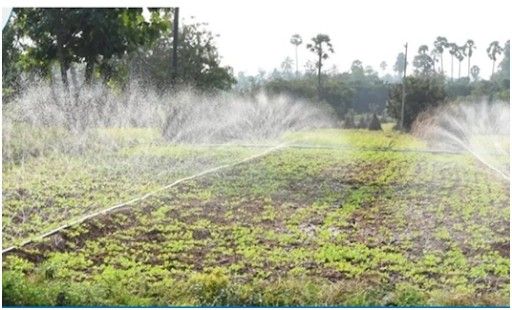
Laser Spray irrigation, commonly known as Rain Pipe / Rain Hose, is a modern irrigation system manufactured from high-quality polyethylene pipes with precisely laser-punched micro-holes. These micro-holes create a gentle, uniform spray pattern that closely mimics natural rainfall, ensuring even water distribution across the field.
Beside irrigating, Spray Irrigation brings a lot of additional benefits:
Laser Spray (Rain Pipe / Rain Hose) irrigation is technically called Spray Irrigation and it substitutes traditional sprinkler irrigation. It stands out with many benefits:
- Supports Photosynthesis: Clean, healthy leaves are key to efficient photosynthesis. By preventing dust buildup on leaves, the Laser Spray (Rain Pipe) ensures that your plants absorb sunlight more effectively, enhancing growth and yield.
- Gentle on Crops: The Laser Spray (Rain Pipe / Rain Hose) disperses fine water droplets, ensuring that your delicate fruits and flowers aren’t damaged during irrigation. This gentle spray mimics natural drizzle, making it ideal for maintaining healthy crops.
- Boosts Soil Health and Germination: The Laser Spray (Rain Pipe) irrigation keeps the soil porous, which improves air circulation around the roots and enhances seed germination. By spreading water evenly across the soil surface, it also reduces the risk of waterlogging and seepage loss.
- Perfect for Sandy Soil: Sandy soils, notorious for their quick drainage, benefit immensely from the Laser Spray’s (Rain Pipe) thin water distribution on the soil. The water penetrates efficiently, keeping the soil moist without being wasted.
- Washes away Insects: Its rain like watering of the plant washes away the insects resulting in reduction crop protection spray of insecticides.
- Cooling the crop: It cools the crop canopy as well as the soil and thus saves the plants form heat stress.
Why Rain Pipe / Rain Hose for Groundnut?
Groundnut is a close-spacing crop. Since driplines can cover only one or two rows of the crop, it will take an economically unviable quantity of driplines to irrigate a plot of land with drip irrigation system. Laser Spray (Rain Pipe / Rain Hose) overcomes this limitation as each Spray Pipe can cover multiple crop rows (up to 6–7 meters in the two sides together). Thus, Laser Spray Irrigation becomes an economical and highly efficient choice for carrot farmers.
Laser Spray (Rain Pipe / Rain Hose) has other advantages for the groundnut cultivation:
• Maintains uniform moisture across the soil surface.
• Keeps soil loose and friable for easy peg penetration.
• Prevents waterlogging and surface crust formation.
Laser Spray (Rain Pipe / Rain Hose) has several advantages over Sprinkler which is also used for close spaced crops:
| Parameter | Laser Spray | Sprinkler |
| Working Pressure | 0.7 kg/cm² | 1.5–4 kg/cm² |
| Pump Required | Lower HP | Higher HP |
| Electricity Consumption | Low | High |
| Maintenance | Low (No moving parts) | Higher |
| Harm to Flowers & Pegs | No | Possible |
| Soil Compaction | No | Possible |
Popular Models of Laser Spray (Rain Pipe / Rain Hose) for Groundnut
a. Laser Spray (Rain Pipe / Rain Hose) 20 mm
b. Laser Spray (Rain Pipe / Rain Hose) 20 mm Gold
c. Laser Spray (Rain Pipe / Rain Hose) 32 mm
d. Laser Spray (Rain Pipe / Rain Hose) 40 mm
e. Laser Spray (Rain Pipe / Rain Hose) 40 mm Marathon – suitable for long fields and large farms
All models ensure fine droplet size, pressure control, and long durability, making them suitable for diverse Indian agro-climatic conditions.
Crop Spacing in Groundnut Cultivation
Proper spacing ensures good aeration, healthy plant growth, and efficient pegging.
Recommended spacing:
• Row-to-Row: 30–45 cm
• Plant-to-Plant: 10–15 cm
This spacing supports uniform irrigation coverage and optimal pod development.
Rain Pipe / Rain Hose (Laser Spray) Installation Spacing
| Model | Recommended Spacing (m) | Recommended Laying Length (m) |
| Laser Spray 20 mm | 3 | 50 |
| Laser Spray 20 mm Gold | 3 | 50 |
| Laser Spray 32 mm | 6–7 | 50 |
| Laser Spray 40 mm | 6–7 | 50 |
| Laser Spray 40 mm Marathon | 6 | 100 |
Results of Rain Pipe / Rain Hose (Laser Spray) Irrigation on Groundnut
1. Improved Germination and Early Growth
Groundnut seeds require uniform moisture during the first 7–10 days. Laser Spray irrigation ensures light and frequent watering, resulting in quick and uniform germination.
2. Better Pegging and Pod Formation
Uniform soil moisture keeps the soil loose, allowing easy peg penetration and healthy pod development without deformation.
3. Higher Yield and Better Productivity
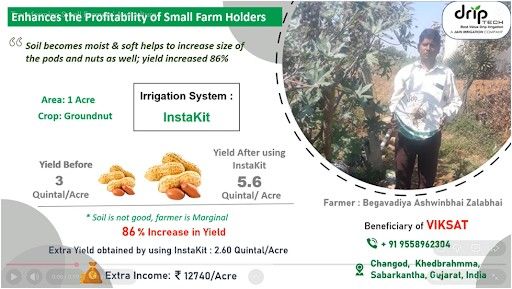
Consistent moisture improves pod size, kernel weight, and oil content. Farmers typically experience 10–20% yield improvement using Driptech Laser Spray systems.
5. Cooling Effect and Heat Stress Reduction
Laser Spray irrigation cools the soil surface during high temperatures, improving crop resilience.
6. Easy Harvesting
Loose and well-aerated soil makes pod lifting easier and reduces labor during harvesting.
Laser Spray (Rain Pipe / Rain Hose) irrigation for Groundnut cultivation:
Please see this video: https://www.youtube.com/watch?v=bg9e1DgssAM
Groundnut Farmer’s success story with Laser Spray cultivation:
Conclusion
Groundnut cultivation with Rain Pipe / Rain Hose (Laser Spray) is a modern, economical, and highly effective irrigation solution. It ensures uniform soil moisture, better germination, healthy pegging, superior pod quality, and higher yields while saving water, power, and labor.
FAQ
1. Is Rain Pipe / Rain Hose (Laser Spray) suitable for groundnut cultivation?
Groundnut is a close-spacing crop. Since driplines can cover only one or two rows of the crop, it will take an economically unviable quantity of driplines to irrigate a plot of land with drip irrigation system. Laser Spray (Rain Pipe / Rain Hose) overcomes this limitation as each Spray Pipe can cover multiple crop rows (up to 6–7 meters in the two sides together). Thus, Laser Spray Irrigation becomes an economical and highly efficient choice for carrot farmers.
Laser Spray (Rain Pipe / Rain Hose) has other advantages for the groundnut cultivation:
• Maintains uniform moisture across the soil surface.
• Keeps soil loose and friable for easy peg penetration.
• Prevents waterlogging and surface crust formation.
2. Why is uniform irrigation important for groundnut?
Uniform irrigation ensures:
- Proper uniform germination
- Healthy flowering and pegging
- Smooth pod development
Uneven moisture can cause flower drop, poor pegging, shriveled pods, and yield loss.
3. How does Laser Spray irrigation help in better pegging?
Laser Spray maintains loose and uniformly moist topsoil, which allows groundnut pegs to penetrate the soil easily. It also prevents soil crusting and compaction that restrict pegging in flood-irrigated fields.
4. Why is Rain Pipe better than flood irrigation for groundnut?
Compared to flood irrigation, Rain Pipe:
- Prevents waterlogging
- Avoids soil compaction and crust formation
- Reduces nutrient leaching
- Saves water and labor
- Improves pegging and pod quality
- Improves yield
Flood irrigation often damages soil structure and negatively affects pod formation.
5. How much water can be saved using Laser Spray irrigation?
Farmers typically report 40–50% water savings compared to flood irrigation due to controlled application leading to better uptake by the plant, reduced evaporation, run-off and seepage.
6. Can Laser Spray irrigation be used in sandy soils?
Absolutely. Laser Spray is ideal for sandy and light soils because it applies water gently and slowly, reducing deep percolation losses and maintaining adequate moisture in the root and pod zone.
7. What pressure is required to operate Rain Pipe irrigation?
Laser Spray works efficiently at low pressure (around 0.7 kg/cm²), requiring a lower HP pump and reducing electricity or diesel consumption.
10. What crop spacing is recommended for groundnut cultivation?
Recommended spacing:
- Row-to-Row: 30–45 cm
- Plant-to-Plant: 10–15 cm
Proper spacing ensures good aeration, uniform irrigation coverage, and efficient pegging.
11. What is the recommended spacing between Rain Pipes in groundnut fields?
Recommended spacing by model:
- 20 mm & 20 mm Gold: 3 meters
- 32 mm & 40 mm: 6–7 meters
- 40 mm Marathon: 6 meters (suitable for long fields)
12. Which Laser Spray model is best for groundnut cultivation?
- Small to medium farms: 20 mm, 20 mm Gold, or 32 mm
- Large farms / long fields: 40 mm or 40 mm Marathon
Selection depends on field size, length, and water source capacity.
13. Does Laser Spray irrigation improve groundnut yield?
Yes. Due to better moisture management, improved pegging, and healthier pod development, farmers generally experience higher yield compared to conventional irrigation methods.
14. Does Laser Spray irrigation help during high-temperature conditions?
Yes. The fine spray provides a cooling effect on both soil and crop canopy, reducing heat stress and improving crop resilience during hot weather.
15. Is Rain Pipe / Rain Hose a long-term solution for groundnut farmers?
Yes. Driptech Rain Pipe systems are durable, low-maintenance, and cost-effective. With proper use, they offer long service life, consistent performance, and sustainable groundnut production.
 +91 80079 78080 / +91 73910 64282