


Introduction
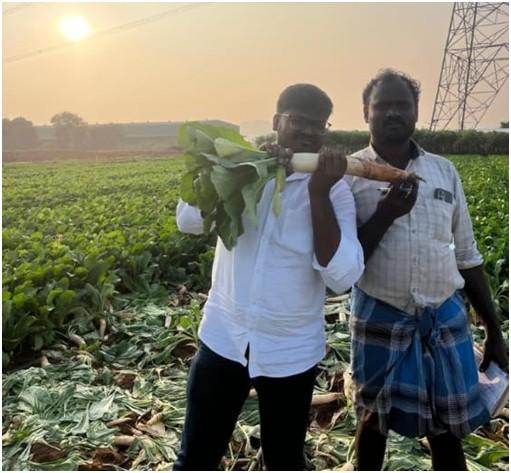
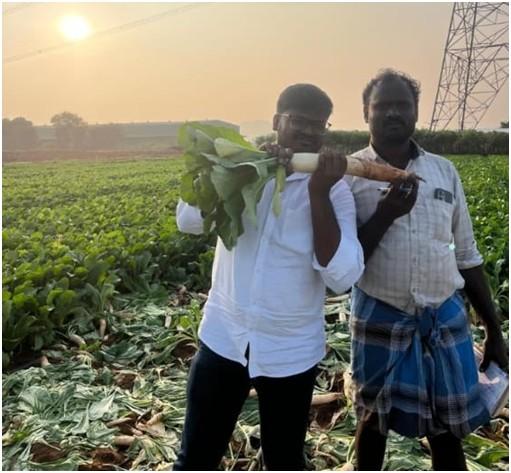
Radish (Raphanus sativus) is one of India’s most widely cultivated root vegetables, preferred for its short crop duration, quick returns, and strong market demand. It is grown across diverse agro-climatic zones for fresh consumption, salads, and culinary preparations. Nutritionally, radish is rich in vitamin C, dietary fiber, potassium, and antioxidants, making it an essential vegetable in daily diets also lets see radish cultivation with rain pipe irrigation.
Successful radish cultivation depends heavily on precise water management and sound agronomical practices. Since radish is a shallow-rooted, fast-growing crop, it requires frequent but light irrigation to maintain consistent soil moisture. Even short periods of moisture stress can lead to pungent taste, poor root enlargement, spongy texture, cracking, and forking of roots. On the other hand, excess irrigation causes waterlogging, nutrient leaching, reduced oxygen availability to roots, and increased incidence of root diseases.
Proper agronomical practices such as fine land preparation, raised beds or well-leveled fields, optimum spacing, timely irrigation, and balanced nutrient application are critical for achieving uniform germination and high-quality roots. Maintaining loose, well-aerated soil is particularly important, as compacted or crusted soil restricts root growth and leads to deformed radishes.
Traditional irrigation methods like flood irrigation often fail to meet these precise requirements. Flooding results in uneven moisture distribution, soil compaction, crust formation on the surface, and wastage of water and nutrients. It also increases labor requirements and creates stress conditions that adversely affect root shape and market quality.
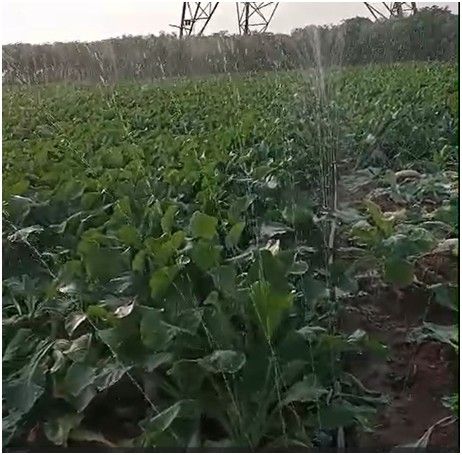
To overcome these challenges, farmers are increasingly adopting Rain Pipe / Rain Hose (Laser Spray) irrigation, an advanced micro-irrigation technique designed to deliver uniform, controlled, and gentle water application. By supplying water in the form of fine, rain-like sprays, Laser Spray irrigation maintains ideal soil moisture levels, supports healthy root development, reduces water losses, and complements good agronomical practices. As a result, it has emerged as a highly efficient, economical, and crop-friendly irrigation solution for radish cultivation.
What is Rain Pipe / Rain Hose (Laser Spray) Irrigation?
Laser Spray irrigation, commonly known as Rain Pipe / Rain Hose, is a modern irrigation system made from high-quality polyethylene pipes with laser-punched micro-holes. These precisely engineered holes produce a gentle and uniform spray pattern that mimics natural rainfall, ensuring even water distribution across the field.
Why Spray Irrigation is a Boon for Farmers
Laser Spray (Rain Pipe / Rain Hose) irrigation is technically called Spray Irrigation and acts as an efficient substitute for traditional sprinkler systems. Its major advantages include:
- Supports Photosynthesis: Clean leaves absorb sunlight more efficiently. The gentle spray prevents dust accumulation on leaves, improving photosynthesis and overall plant growth.
- Gentle on Crops: Fine water droplets do not damage tender radish leaves or disturb young seedlings.
- Boosts Soil Health and Germination: Maintains soil porosity, improves aeration, and ensures quick and uniform seed germination.
- Perfect for Sandy Soils: Thin, controlled water application prevents rapid percolation losses and maintains moisture in fast-draining soils.
- Washes Away Insects: Rain-like spray helps wash off insects, reducing dependence on chemical insecticides.
- Cooling Effect: Cools both the crop canopy and soil surface, protecting radish crops from heat stress.
Why radish cultivation with rain pipe irrigation?
Radish is a close-spacing root crop. Drip irrigation can irrigate only one or two rows at a time, making it economically unviable due to the high number of driplines required.
Laser Spray (Rain Pipe / Rain Hose) overcomes this limitation because a single pipe can cover multiple crop rows (up to 6–7 meters on both sides together). This makes it a cost-effective, efficient, and farmer-friendly irrigation solution for radish cultivation.
Additional Advantages for Radish Farmers
- Maintains uniform moisture from the topsoil to the root zone, essential for smooth root development
- Prevents soil crust formation, allowing easy emergence of delicate radish seedlings
- Fine water droplets do not displace seeds or expose roots
Laser Spray vs Sprinkler Irrigation
| Parameter | Laser Spray | Sprinkler |
| Working Pressure | 0.7 kg/cm² | 1.5–4 kg/cm² |
| Pump Required | Lower HP | Higher HP |
| Electricity Consumption | Low | High |
| Maintenance | Low (No moving parts) | Higher |
| Harm to Fruits & Flowers | No | Possible |
| Soil Compaction | No | Possible |
Popular Models of Laser Spray (Rain Pipe / Rain Hose) for Radish
a. Laser Spray (Rain Pipe / Rain Hose) 20 mm
b. Laser Spray (Rain Pipe / Rain Hose) 20 mm Gold
c. Laser Spray (Rain Pipe / Rain Hose) 32 mm
d. Laser Spray (Rain Pipe / Rain Hose) 40 mm
e. Laser Spray (Rain Pipe / Rain Hose) 40 mm Marathon – suitable for long fields and large farms
All models ensure fine droplet size, pressure control, and long durability, making them suitable for diverse Indian agro-climatic conditions.
Crop Spacing in Radish Cultivation
Proper spacing ensures good root size, uniform growth, and adequate air circulation.
Recommended spacing:
- Row-to-Row: 30–45 cm
- Plant-to-Plant: 8–10 cm
This spacing helps produce straight, well-shaped, market-grade radishes.
Rain Pipe / Rain Hose (Laser Spray) Installation Spacing
| Model | Recommended Spacing (m) | Recommended Laying Length (m) |
| Laser Spray 20 mm | 3 | 50 |
| Laser Spray 20 mm Gold | 3 | 50 |
| Laser Spray 32 mm | 6–7 | 50 |
| Laser Spray 40 mm | 6–7 | 50 |
| Laser Spray 40 mm Marathon | 6 | 100 |
Results of Rain Pipe / Rain Hose (Laser Spray) Irrigation on Radish
1. Improved Germination and Early Growth
Radish seeds require consistent moisture for the first 7–10 days. Rain Pipe irrigation ensures light and frequent watering, resulting in fast and uniform germination.
2. Smooth and Uniform Root Formation
Uniform soil moisture prevents:
- Root cracking
- Forking
- Hollow or spongy roots
Farmers obtain smooth, crisp, and uniform radishes.
3. Higher Yield and Better Productivity
Consistent moisture improves root length, thickness, and weight. Farmers typically experience 10–20% yield improvement using Driptech Laser Spray (Rain Pipe / Rain Hose).
4. Easy Harvesting
The soil remains loose and non-compacted, making radish uprooting easy and reducing labor during harvest.
Farmers’ Experiences
Radish growers using Driptech Rain Pipe systems report excellent water efficiency, uniform crop stand, improved root quality, and reduced irrigation costs.
Here are some videos of real farmer experiences using Driptech Rain Pipe (Laser Spray) in Radish Cultivation:
https://www.youtube.com/watch?v=G6yrMonFQP0
Conclusion
Radish cultivation with Rain Pipe / Rain Hose (Laser Spray) is a modern, economical, and highly effective irrigation solution. It ensures uniform soil moisture, better germination, superior root quality, higher yields, and significant savings in water, power, and labor.
FAQ
1. Is Rain Pipe / Rain Hose suitable for radish cultivation?
Yes. Radish requires frequent but light and uniform irrigation. Rain Pipe (Laser Spray) provides gentle, rain-like water application that supports good germination, healthy root development, and prevents soil crusting.
2. Why is precise water management important in radish cultivation?
Radish is a shallow-rooted and fast-growing crop. Even short periods of moisture stress can cause pungency, poor root enlargement, cracking, and forking. Excess irrigation can lead to waterlogging, nutrient loss, and root diseases. Rain Pipe irrigation helps maintain ideal soil moisture balance.
3. How does Laser Spray irrigation improve seed germination in radish?
Laser Spray delivers fine and uniform water droplets that keep the topsoil consistently moist during the first 7–10 days after sowing. This ensures quick, uniform, and healthy germination without washing away seeds.
4. What are the advantages of Rain Pipe over flood irrigation for radish?
Compared to flood irrigation, Rain Pipe irrigation:
- Provides uniform moisture distribution
- Prevents soil compaction and surface crusting
- Reduces water and nutrient wastage
- Lowers labor requirement
- Improves root shape and market quality
5. Why is Rain Pipe more economical than drip irrigation for radish?
Radish is a close-spacing crop. Drip irrigation can cover only one or two rows per lateral, making it costly. A single Rain Pipe can cover multiple rows (up to 6–7 meters on both sides together), making it a more economical and efficient solution.
6. How does Laser Spray irrigation help in achieving smooth and uniform radish roots?
By maintaining uniform moisture from the soil surface to the root zone, Laser Spray prevents:
- Root cracking
- Forking
- Hollow or spongy roots
This results in smooth, straight, and market-grade radishes.
7. What is the recommended crop spacing for radish cultivation?
- Row-to-Row: 30–45 cm
- Plant-to-Plant: 8–10 cm
Proper spacing ensures good root size, air circulation, and uniform growth.
8. What spacing should be maintained between Rain Pipes in radish fields?
Recommended Rain Pipe spacing based on model:
- 20 mm & 20 mm Gold: 3 meters
- 32 mm & 40 mm: 6–7 meters
- 40 mm Marathon: 6 meters (for long fields)
9. How does Rain Pipe irrigation save water and electricity?
Rain Pipe works at low pressure (around 0.7 kg/cm²), requiring a lower HP pump. This reduces electricity or diesel consumption while ensuring efficient water use with minimal losses.
10. Does Laser Spray irrigation help in pest management?
Yes. The rain-like spray helps wash away insects from plant surfaces, reducing pest pressure and the need for frequent insecticide sprays.
11. Can Rain Pipe irrigation be used in different soil types?
Yes. Rain Pipe works effectively in sandy, loamy, and clay soils. It prevents rapid percolation in sandy soils and avoids waterlogging in heavier soils.
12. What yield improvement can farmers expect with Laser Spray irrigation in radish?
Farmers typically experience 10–20% higher yield due to improved germination, uniform root development, and better moisture management.
13. Does Rain Pipe irrigation make harvesting easier?
Yes. The soil remains loose and non-compacted, allowing easy uprooting of radishes and reducing labor during harvest.
14. Which Laser Spray model is best for radish cultivation?
- Small to medium farms: 20 mm, 20 mm Gold, or 32 mm
- Large farms or long fields: 40 mm or 40 mm Marathon
15. Is Rain Pipe / Rain Hose a long-term solution for radish farmers?
Yes. Driptech Rain Pipe systems are durable, low-maintenance, and designed for long-term use, offering consistent performance, lower operating costs, and sustainable radish production.
 +91 80079 78080 / +91 73910 64282